
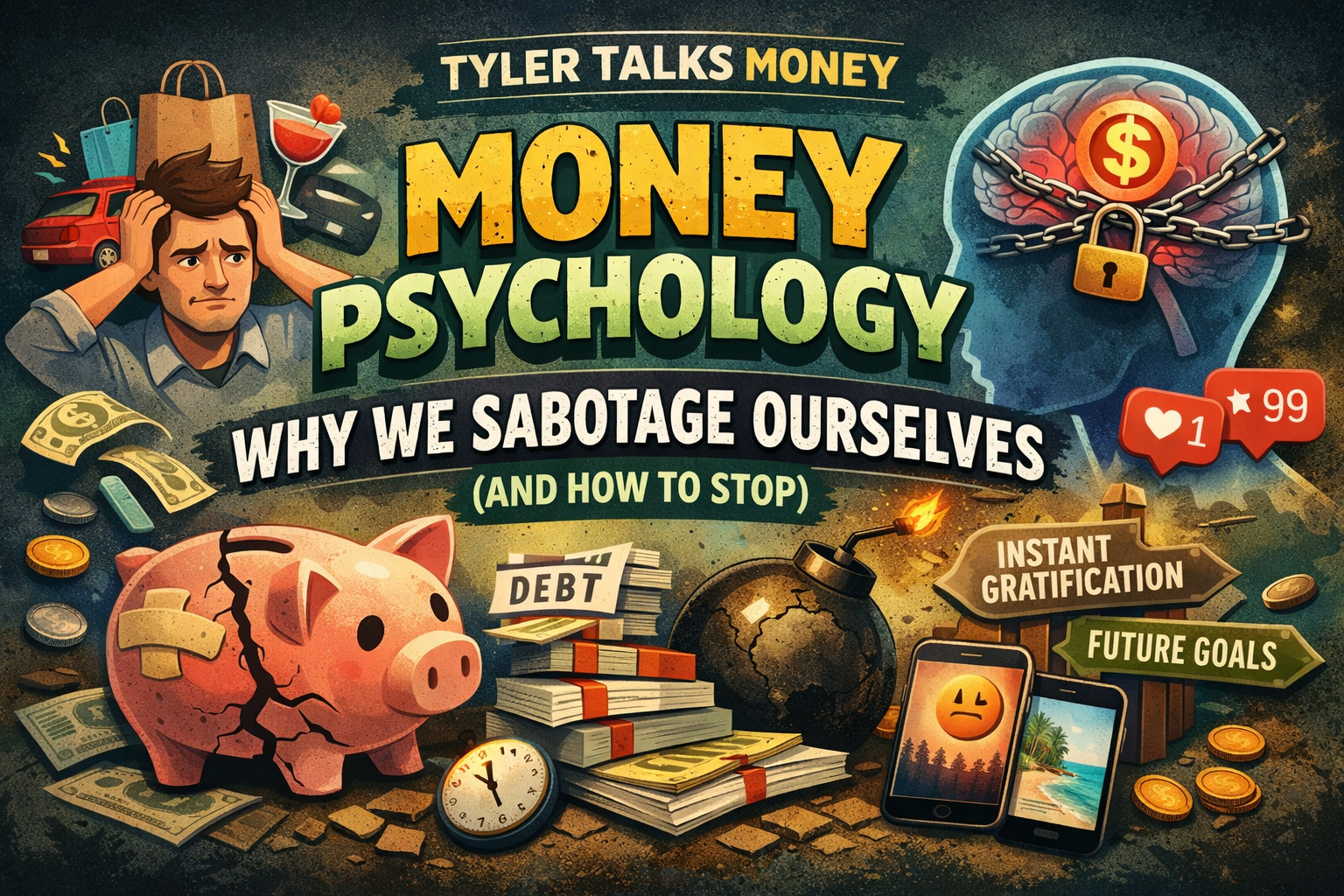
If money were just math, everyone with a calculator would be rich.
But you already know that’s not how this works.
Most money problems aren’t caused by lack of income, lack of intelligence, or even bad advice. They’re caused by how our brains react to stress, emotion, comparison, and instant gratification.
In other words: your biggest financial enemy probably lives between your ears.
This post is a refresher on the why behind our money behavior — because once you understand it, everything else (budgeting, saving, investing, debt payoff) gets a lot easier.
Why We’re Bad With Money (Even When We Know Better)
Let’s clear something up first:
You’re not broken.
You’re not lazy.
You’re not “bad with money.”
You’re human.
Our brains are wired for survival and comfort, not 30-year retirement plans or compound interest charts. That mismatch creates some very predictable money mistakes.
Here are the big ones.
1. Present You vs. Future You
Your brain treats future you like a stranger.
That’s why:
- You’ll swipe the card today and “deal with it later”
- Retirement feels fake until you’re way closer to it
- Saving feels like punishment, not progress
Future you doesn’t feel real — so present you wins every time.
How to stop sabotaging yourself:
- Automate savings so future you gets paid before you can interfere
- Tie savings to a specific goal (“house down payment,” “freedom fund”) instead of a vague “someday”
- Make progress visible — balances growing feels way better than abstract discipline
2. Lifestyle Creep (The Sneakiest One)
You don’t suddenly start living recklessly.
You just slowly upgrade everything.
A nicer apartment.
A better car.
More subscriptions.
“Just this once” turning into every month.
Your income goes up… but your bank account stays suspiciously the same.
How to stop sabotaging yourself:
- Lock in raises and bonuses before you see them (increase savings first)
- Keep your “baseline lifestyle” stable even as income grows
- Ask: Did this actually improve my life — or just my monthly bills?
3. Emotional Spending Is Real (And Expensive)
Nobody budgets for:
- Stress spending
- Boredom spending
- “I deserve this” spending
- “That week sucked” spending
But it adds up fast.
Money becomes a coping mechanism, not a tool.
How to stop sabotaging yourself:
- Build a small, guilt-free “fun money” category
- Pause 24 hours on non-essential purchases
- Identify your triggers — tired, stressed, bored, social pressure
Awareness alone cuts a ton of waste.
4. Comparison Will Wreck Your Finances
Social media makes it look like:
- Everyone has a nicer house
- Everyone travels constantly
- Everyone is winning except you
What you don’t see:
- The debt
- The stress
- The payments
- The financial anxiety behind the photos
Keeping up with people you don’t know using money you don’t have is a guaranteed way to stay stuck.
How to stop sabotaging yourself:
- Mute accounts that make you feel behind
- Measure progress against your own past, not someone else’s highlight reel
- Remember: expensive doesn’t mean successful
5. Fear Makes Us Freeze
A lot of people don’t mess up money — they avoid it completely.
They don’t look at balances.
They don’t open statements.
They don’t start investing because they’re scared to “do it wrong.”
Avoidance feels safe… until it costs you years of progress.
How to stop sabotaging yourself:
- Start small enough that you can’t mess it up
- Focus on consistency, not perfection
- Understand that doing something imperfectly beats doing nothing perfectly
How to Actually Fix the Problem
Here’s the key takeaway:
👉 Good money habits beat motivation every time
You don’t need willpower. You need systems.
- Automate saving and investing
- Simplify accounts and goals
- Make decisions once, not every month
- Remove friction from good habits and add friction to bad ones
When your money runs on autopilot, your emotions stop running the show.
Final Thought
Most financial advice focuses on what to do.
But until you understand why you act the way you do with money, nothing sticks.
Fix the mindset → the behavior follows → the math finally works.
You don’t need to be perfect.
You just need to stop fighting your own brain.
Disclosure:
This content is intended solely for general financial education and discussion. It does not constitute advice, recommendations, or solicitation of any kind. The author is not providing services as a financial advisor, investment advisor, tax advisor, or legal advisor. All views expressed are personal and do not represent the views, policies, or positions of the author’s employer or any affiliated institution. No compensation has been received for this content. Any financial decisions should be made in consultation with appropriately licensed professionals.