Everyone has that idea.
The one you think about in the shower.
The one you talk about after a couple beers.
The one that starts with, “If I ever quit my job…”
But then reality kicks in:
- Bills still need to be paid
- Health insurance is expensive
- And “leaving a steady paycheck” feels like jumping out of a plane without checking the parachute
So the real question isn’t “Should I do it?”
It’s how should you do it.
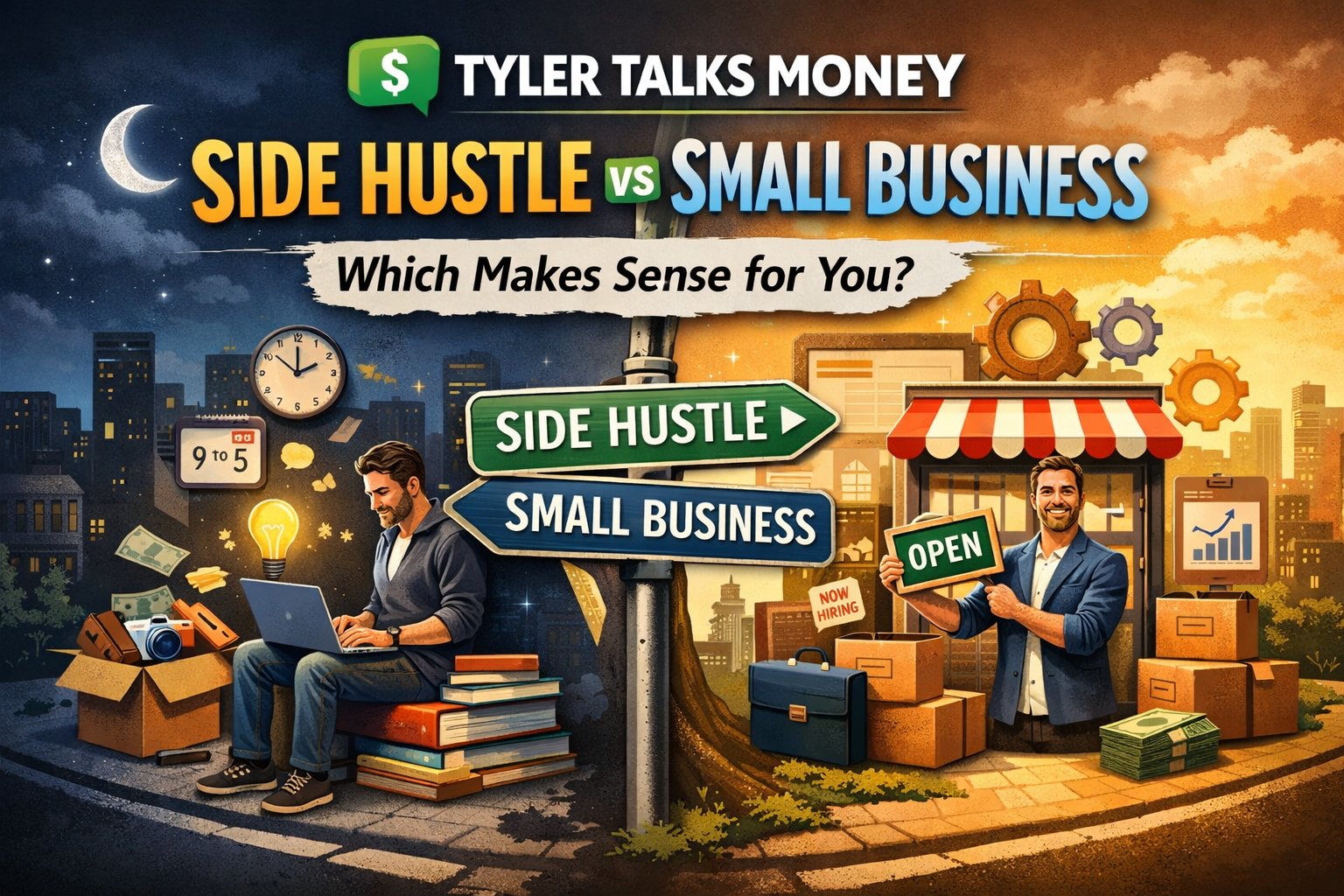
Do you start with a side hustle…
or jump straight into building a small business?
Let’s break it down.
First Things First: What’s the Difference?
People use these terms interchangeably, but they’re not the same thing.
A Side Hustle
A side hustle is:
- Something you do outside your main job
- Usually nights, weekends, or nap time
- Low upfront cost
- Low pressure
- Meant to supplement your income
Examples:
- Freelance work
- A blog or content page
- Coaching, tutoring, consulting
- Selling products online
- Service-based work (lawn care, pressure washing, photography)
Think of a side hustle as testing an idea with training wheels on.
A Small Business
A small business is:
- A primary income source (or aiming to be)
- Requires more time, structure, and risk
- Often involves employees, leases, or inventory
- Usually replaces or significantly reduces your day job
Examples:
- Brick-and-mortar stores
- Full-time service companies
- Restaurants
- Trades and contracting businesses
- Scaled online businesses with consistent revenue
This is the deep end of the pool.
Why Most People Shouldn’t Jump Straight Into a Small Business
Here’s the banker side of me talking for a second.
Most small businesses don’t fail because the idea is bad.
They fail because cash flow dries up.
Common mistakes:
- Quitting the job too early
- Underestimating expenses
- Overestimating how fast money comes in
- Stress decisions driven by panic, not planning
Your paycheck is boring — but boring is powerful.
A steady income:
- Buys you time
- Buys you patience
- Buys you better decisions
That’s why a side hustle is often the smarter first move, not the “safe” one.
When a Side Hustle Makes the Most Sense
A side hustle is the right move if:
- You have an idea but don’t know if it’ll work
- You’re risk-averse (no shame there)
- You have a family relying on your income
- You want to build skills before going all in
- You’d rather grow slowly than stress daily
Side hustles let you:
- Test demand
- Learn pricing
- Make mistakes quietly
- Build confidence
- Stack cash
No investors.
No pressure.
No dramatic LinkedIn post about “taking the leap.”
When a Small Business Might Be the Right Call
There are times when jumping in makes sense.
A small business may be the right move if:
- You already have paying customers
- Demand exceeds your available side hustle time
- You’ve saved 6–12 months of expenses
- You understand your costs and margins
- You’re mentally prepared for income swings
This isn’t about courage — it’s about readiness.
Taking the leap shouldn’t feel reckless.
It should feel calculated.
The Hybrid Approach (What Most People Miss)
Here’s the path I see work most often:
Side Hustle → Proof → Scale → Transition
- Start as a side hustle
- Prove people will pay
- Systemize and grow
- Transition when income becomes predictable
This removes emotion from the decision.
You’re not quitting because you’re “fed up.”
You’re quitting because the numbers say it’s time.
That’s a huge difference.
Ask Yourself These Questions Before Deciding
Before choosing a path, ask:
- Can this idea make money without me being there 24/7?
- Do people already pay for something like this?
- How much upfront cash does it really need?
- What happens if income drops for 3 months?
- Am I chasing freedom… or running from my job?
Be honest. Your bank account already knows the truth.
Final Thought
You don’t need to gamble your livelihood to chase an idea.
Starting small doesn’t mean thinking small.
It means thinking long-term.
Most successful businesses didn’t start with a dramatic leap —
they started quietly, on nights and weekends, while bills were still getting paid.
If you’ve got an idea sitting in your head…
maybe the next step isn’t quitting your job.
Maybe it’s just starting.
Disclosure:
This content is intended solely for general financial education and discussion. It does not constitute advice, recommendations, or solicitation of any kind. The author is not providing services as a financial advisor, investment advisor, tax advisor, or legal advisor. All views expressed are personal and do not represent the views, policies, or positions of the author’s employer or any affiliated institution. No compensation has been received for this content. Any financial decisions should be made in consultation with appropriately licensed professionals.