
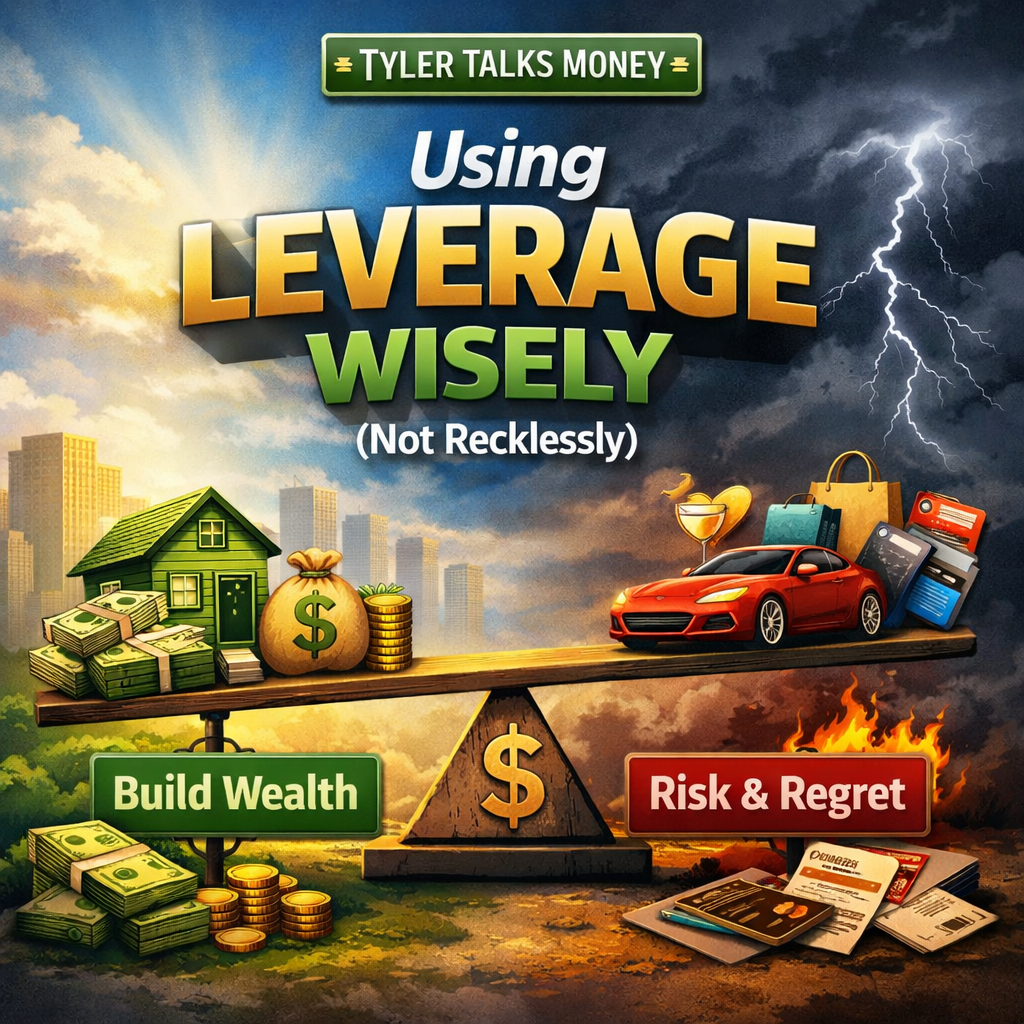
Debt gets a bad rap.
For some people, it’s a four-letter word.
For others, it’s a shiny toy they overuse until things go sideways.
The truth?
Debt itself isn’t good or bad. It’s just leverage.
And leverage—when used correctly—can speed things up. When used recklessly, it can wreck your life.
This post is a refresher from the Personal Finance Foundations phase and a transition into what’s next: scaling wealth intentionally instead of just “getting by.”
Let’s talk about how leverage actually works—without the scare tactics or Instagram nonsense.
What Leverage Really Is (In Plain English)
Leverage is simply using borrowed money to control something bigger than what your cash alone would allow.
That’s it.
A mortgage is leverage.
A business loan is leverage.
A student loan can be leverage.
A maxed-out credit card for a vacation is… not.
Leverage isn’t the villain.
Misusing leverage is.
Think of it like a chainsaw:
- Great tool when used correctly
- Horrible idea when used blindly
The Two Types of Debt (This Matters)
Not all debt belongs in the same bucket.
1. Productive Debt (The “Can Help You” Kind)
This type of debt:
- Has a long-term payoff
- Helps you earn more, save more, or grow assets
- Is usually tied to something that lasts
Examples:
- A reasonably priced mortgage
- Student loans tied to actual earning power
- Business loans used to increase revenue
- Real estate investment debt that cash flows (or has a clear plan)
This is the debt people quietly use to build wealth—while pretending they didn’t.
2. Consumptive Debt (The “Feels Good Now” Kind)
This type of debt:
- Funds things that lose value
- Solves short-term wants with long-term payments
- Comes with high interest and zero upside
Examples:
- Credit cards for lifestyle spending
- Personal loans for “vibes”
- Financing toys you can’t actually afford
- Buy Now, Pay Later for stuff you forgot you bought
This is the debt that makes people say, “I make good money but feel broke.”
Why “Debt-Free At All Costs” Is the Wrong Goal
Being debt-free feels safe. I get it.
But safety and progress aren’t always the same thing.
Avoiding all debt can:
- Slow down wealth building
- Force you to wait forever to invest
- Keep you playing small while time keeps moving
Meanwhile, the people who understand leverage:
- Buy homes earlier
- Start businesses sooner
- Invest with intention
- Let time and compounding do the heavy lifting
The goal isn’t “no debt.”
The goal is smart debt you can control.
Rules for Using Leverage Wisely
Before taking on any debt, ask yourself:
1. Does this increase future income or net worth?
If the answer is no, proceed carefully.
2. Can I comfortably afford this if things go sideways?
Job loss, slower business, surprise expenses—plan for reality, not best-case scenarios.
3. Is the interest rate reasonable?
High interest turns “leverage” into “anchors.”
4. Do I have a clear exit plan?
Payoff strategy > vibes.
If you can’t clearly explain why the debt exists and how it helps you long term… that’s your answer.
Leverage Is a Multiplier (Good or Bad)
This is the part people miss.
Leverage amplifies whatever you’re already doing:
- Good decisions → faster progress
- Bad habits → faster problems
Debt doesn’t fix discipline issues.
It doesn’t replace planning.
It doesn’t turn bad math into good math.
Used wisely, leverage accelerates growth.
Used recklessly, it accelerates regret.
Where This Fits in the Bigger Picture
In the Personal Finance Foundations phase, we focused on:
- Cash flow
- Budgeting
- Emergency funds
- Understanding your numbers
That’s the floor.
The next phase—scaling wealth—is about:
- Strategy
- Intentional leverage
- Playing offense without blowing up defense
Leverage is the bridge between surviving and scaling.
And like any bridge, you don’t sprint across it blindfolded.
Final Thought
Debt isn’t the enemy.
Ignoring how it works is.
You don’t need to fear leverage—but you do need to respect it.
Used wisely, it can help you move faster than cash alone ever could.
Used recklessly, it’ll keep you busy paying for yesterday instead of building tomorrow.
Next up: we start talking about how people actually scale wealth on purpose—not by luck, not by hype, and definitely not by maxing out credit cards.
Stay tuned.
Disclosure:
This content is intended solely for general financial education and discussion. It does not constitute advice, recommendations, or solicitation of any kind. The author is not providing services as a financial advisor, investment advisor, tax advisor, or legal advisor. All views expressed are personal and do not represent the views, policies, or positions of the author’s employer or any affiliated institution. No compensation has been received for this content. Any financial decisions should be made in consultation with appropriately licensed professionals.