
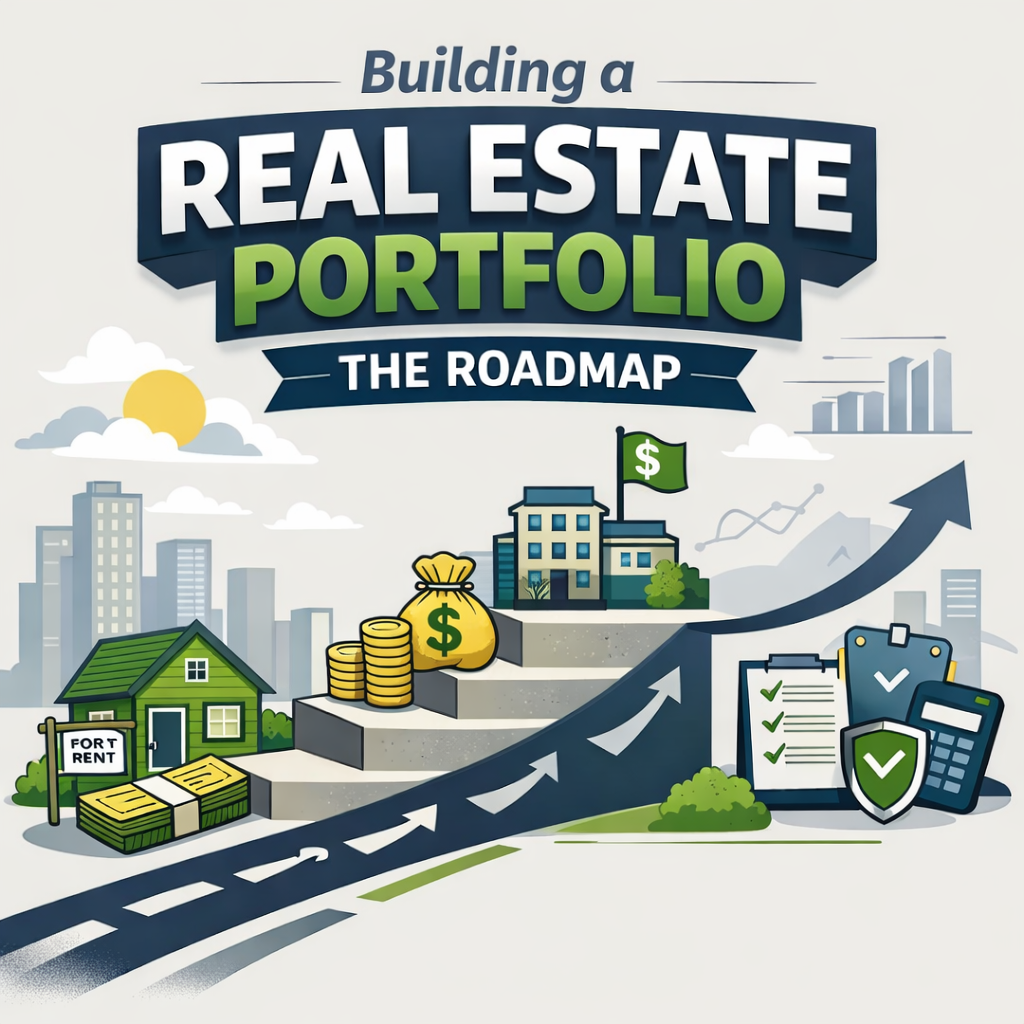
Up to this point, we’ve talked about foundations—budgeting, debt, investing basics, and using money with intention—making it work for you.
Now comes Phase 3, where things get more strategic.
This is where real estate starts to shine.
Real estate isn’t a “get rich quick” scheme. It’s a get wealthy slowly, on purpose strategy. When done correctly, it creates income, appreciation, tax advantages, and leverage—four tools that are hard to find in one place.
This post is your roadmap. Not a hype piece. Not guru nonsense. Just a clear path from first property to portfolio mindset.
Why Real Estate Is a Scaling Tool
Most people start investing with stocks—and that’s great. But stocks are mostly passive growth. Real estate lets you:
- Use leverage (control large assets with less cash)
- Increase value through action (renovations, rent optimization)
- Generate cash flow
- Benefit from tax advantages
Think of real estate as a business disguised as an asset.
Step 1: Get Your Financial Base Solid
Before you buy anything, you need stability.
That means:
- Emergency fund in place
- Manageable consumer debt
- Decent credit
- Stable income
Real estate magnifies decisions. Good foundations = powerful results. Weak foundations = stress and sleepless nights.
Rule of thumb: If one vacancy would wreck you financially, you’re not ready yet.
Step 2: Your First Property (The Entry Point)
Most portfolios don’t start with a skyscraper. They start with something boring—and boring is beautiful.
Common first steps:
- Primary residence with long-term appreciation
- House hacking (duplex, triplex, or renting rooms)
- Small single-family rental
The goal here isn’t perfection. It’s experience.
You’re learning:
- How financing actually works
- What expenses really look like
- How tenants behave in the real world
This is your training ground.
Step 3: Understand Cash Flow (Before Scaling)
Cash flow is what keeps portfolios alive.
At a basic level:
Rent – Expenses = Cash Flow
Expenses include:
- Mortgage
- Taxes & insurance
- Maintenance
- Vacancies
- Property management (even if it’s “future you”)
A property doesn’t need massive cash flow—but it needs to at least pay for itself. Appreciation is a bonus. Cash flow is survival.
Step 4: Leverage & Equity (The Growth Engine)
This is where real estate separates itself.
As tenants pay down your loan and property values rise, you build equity. That equity can be reused to:
- Buy additional properties
- Improve existing ones
- Refinance into better terms
This isn’t reckless borrowing—it’s strategic leverage.
Used wisely, leverage accelerates growth. Used poorly, it becomes a trap. The difference is cash flow and discipline.
Step 5: Transition From “Property Owner” to “Portfolio Thinker”
One property is an investment.
Multiple properties are a system.
At this stage, decisions become more strategic:
- Diversifying locations
- Mixing property types
- Deciding when to self-manage vs outsource
- Tracking performance like a business
Your goal shifts from buying properties to building a machine that supports your life.
Step 6: Risk Management (The Part Nobody Brags About)
Scaling wealth isn’t about avoiding risk—it’s about managing it.
Smart investors plan for:
- Vacancies
- Repairs
- Market cycles
- Interest rate changes
Cash reserves, conservative projections, and patience matter more than flashy returns.
If it looks too good to be true, it usually is.
The Big Picture
Real estate isn’t about overnight success. It’s about compounding decisions over time.
One property becomes two.
Two become a portfolio.
A portfolio becomes options.
And options—time, freedom, flexibility—are the real definition of wealth.
Final Thought
You don’t need dozens of properties.
You don’t need to be a full-time landlord.
You just need a plan and the patience to follow it.
Phase 3 isn’t about working harder—it’s about working smarter, with strategy.
Disclosure:
This content is intended solely for general financial education and discussion. It does not constitute advice, recommendations, or solicitation of any kind. The author is not providing services as a financial advisor, investment advisor, tax advisor, or legal advisor. All views expressed are personal and do not represent the views, policies, or positions of the author’s employer or any affiliated institution. No compensation has been received for this content. Any financial decisions should be made in consultation with appropriately licensed professionals.