
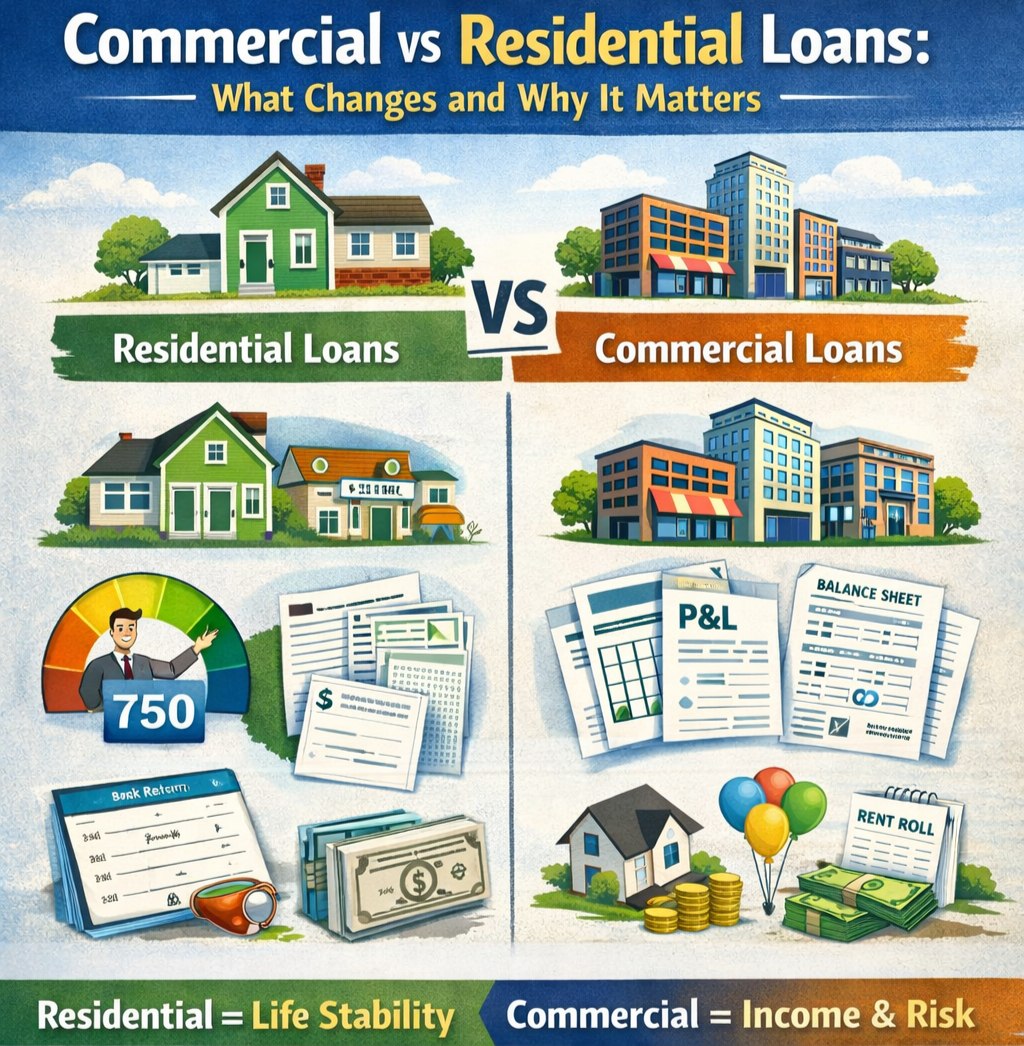
At first glance, a loan is a loan.
Money goes out, payments come back — seems simple enough.
But once you move beyond buying a primary home, the difference between residential and commercial loans starts to matter — a lot.
Understanding how these loans are structured (and why) can save you time, confusion, and incorrect assumptions before you ever sit down with a lender.
Let’s break it down.
The Core Difference
The biggest distinction between residential and commercial lending comes down to what’s being evaluated.
- Residential loans focus primarily on you — your income, credit, and personal financial picture.
- Commercial loans focus primarily on the deal — the property or business, its income, and the overall risk.
That one shift changes how the loan is reviewed, what documentation is required, and how decisions are made.
Think of it this way:
- Residential lending answers: “Can this person afford this?”
- Commercial lending answers: “Does this deal make sense and sustain itself?”
That single difference drives nearly everything else.
What Qualifies as Residential?
Residential loans typically apply to:
- Primary residences
- Second homes
- 1–4 unit properties, including rentals
Even if a property is an investment, it can still fall under residential lending as long as it stays within the 1–4 unit range and is structured appropriately.
Residential loans are generally designed to be:
- Long-term
- Predictable
- Centered around personal income and stability
Because these loans are tied closely to personal housing, the rules are more standardized and familiar to most borrowers.
What Qualifies as Commercial?
Commercial loans usually apply to properties that exist primarily to generate income or support a business, such as:
- Office buildings
- Retail spaces
- Warehouses
- Apartment buildings with 5 or more units
- Owner-occupied business properties
Once a property operates at a larger scale or is tied directly to business operations, it typically falls into the commercial category.
Commercial lending assumes:
- Income may fluctuate
- The property or business must support the debt
- The borrower may refinance, sell, or restructure in the future
Because of that, the structure and expectations are different by design.
The Gray Area: 1–4 Unit Rental Properties
This is where things get interesting — and where most confusion happens.
1–4 unit rental properties can be treated as either residential or commercial, depending on how the loan is structured, not just the property itself.
In general:
- If the loan is taken in your personal name, it is typically structured under residential lending guidelines, even if the property is a rental.
- If the loan is taken in a business entity (such as an LLC), it is generally structured as a commercial loan.
Same property.
Same number of units.
Different structure.
Different underwriting approach.
This is why two investors can buy nearly identical duplexes and walk away with very different loan experiences.
How Approval Is Evaluated
Residential Lending
Residential loan approval is centered around the borrower’s personal financial profile, including:
- Personal income
- Credit history
- Debt-to-income ratio
- Personal assets and reserves
The property matters, but the borrower is the primary focus. The lender is essentially asking whether you can support the loan over the long term.
Commercial Lending
Commercial loan approval leans more heavily on the performance of the deal itself, including:
- Property or business cash flow
- Debt service coverage
- Financial statements
- Borrower experience and liquidity
Personal credit still matters — but it’s no longer the main driver. The deal has to stand on its own.
Loan Structure & Expectations
Residential loans are typically designed for stability and simplicity:
- Longer amortization periods
- Predictable payments
- Structures meant to be held long-term
Commercial loans are designed for flexibility and risk management:
- Shorter terms (3 or 5 years common)
- Different repayment structures
- Assumptions that the borrower may refinance, sell, or reposition the property
Neither approach is better — they’re simply built for different goals and realities.
Why This Difference Matters
Most problems don’t come from bad deals — they come from bad expectations.
Expecting residential rules in a commercial setting can lead to:
- Surprise documentation requests
- Different underwriting timelines
- Confusion around structure and terms
Understanding which category your loan falls into before you apply helps the entire process move more smoothly and avoids unnecessary frustration.
Final Thought
Residential loans are designed around personal financial stability.
Commercial loans are designed around income, risk, and sustainability.
Knowing which world you’re operating in — and how your loan is structured — makes a bigger difference than most people realize.
Disclosure:
This content is intended solely for general financial education and discussion. It does not constitute advice, recommendations, or solicitation of any kind. The author is not providing services as a financial advisor, investment advisor, tax advisor, or legal advisor. All views expressed are personal and do not represent the views, policies, or positions of the author’s employer or any affiliated institution. No compensation has been received for this content. Any financial decisions should be made in consultation with appropriately licensed professionals.