
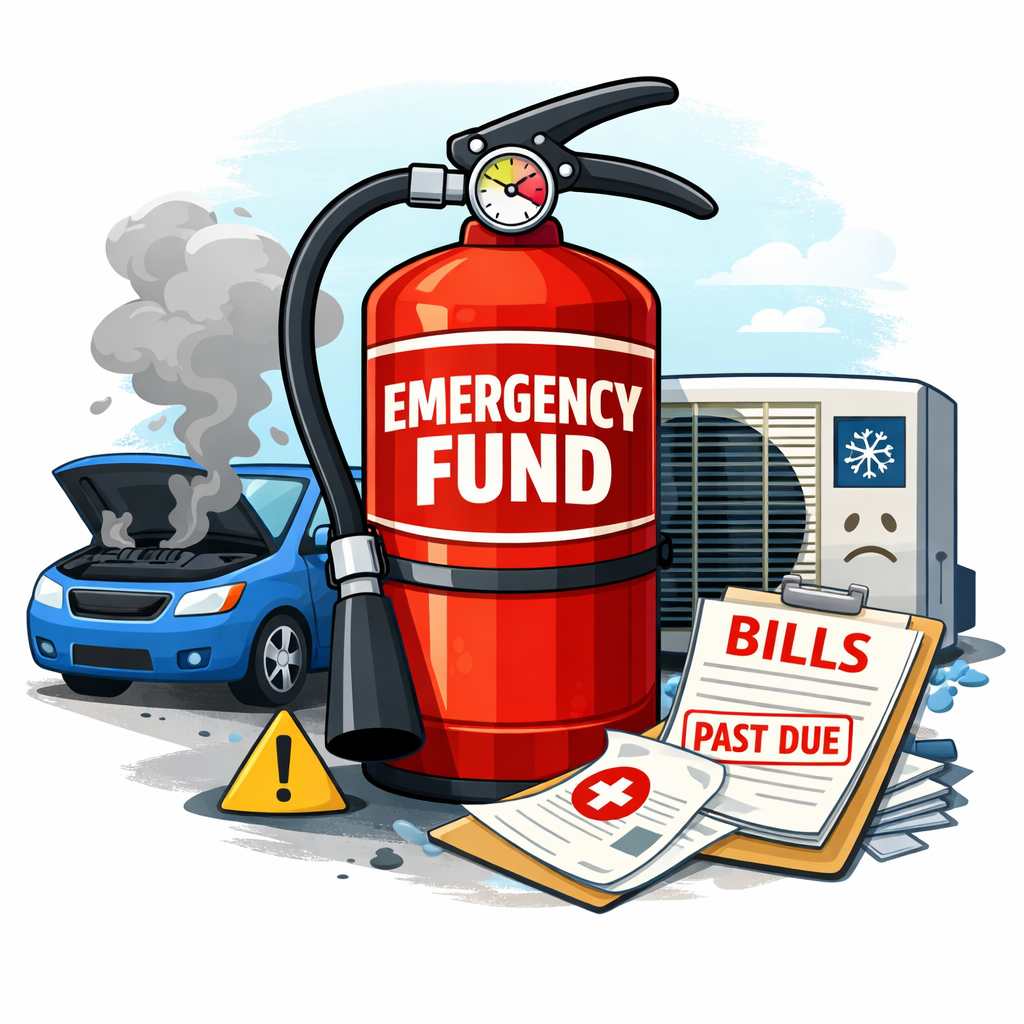
There’s a difference between being broke and being one inconvenience away from broke.
That second one is what an emergency fund protects you from.
Life has a talent for throwing curveballs at the exact worst times: the AC dies in July, your car suddenly sounds like a jet engine, the dog decides to swallow a sock, or your job decides “Hey, what if we didn’t need you anymore?”
An emergency fund is not a luxury.
It’s not something “rich people do.”
It’s not even really optional if you want financial stability.
It is your financial shock absorber.
What an Emergency Fund Is (and Isn’t)
It IS:
- Cash you can access quickly
- Money meant for real emergencies
- Your buffer between “annoying” and “life crisis”
It ISN’T:
- Vacation money
- Shopping money
- “I saw a great deal on a TV and it would be a shame not to buy it” money
If it has a remote, wheels, upgrade button, or involves Margaritaville… it’s not an emergency.
Why an Emergency Fund Matters
Because bad things don’t schedule appointments.
Without an emergency fund, most people do one of three things:
- Panic
- Swipe a credit card
- Take out a high-interest loan
- (Bonus option) Pretend the problem doesn’t exist and hope for the best
That leads to stress, debt, and worse financial decisions down the road.
With an emergency fund?
You still might not enjoy the emergency (shocker), but you don’t have to go financially backward every time something goes wrong.
So… How Big Should It Be?
Here’s where the internet usually screams:
“YOU NEED 6–12 MONTHS OF EXPENSES OR YOU’RE A RECKLESS HUMAN BEING.”
Let’s relax.
Different lives require different levels of cushion.
The Realistic Ranges
Starter Goal: $1,000 – $2,500
Perfect for:
- People getting started
- Those still paying down high-interest debt
- Anyone who doesn’t want to get wrecked by a flat tire
This covers the “annoying life stuff.”
Comfort Zone: 1–3 Months of Expenses
This is where most people should live.
Covers:
- Job hiccups
- Medical surprises
- Big “uh-oh” expenses
This is also personally where I land. I like around 3 months of expenses. It’s enough to breathe. It’s enough to sleep at night. And it’s realistic for most households.
Maximum Security Mode: 6 Months+
Recommended for:
- Single-income households
- Commission-based income
- Business owners
- Highly unstable job industries
If losing your job means the household takes a major financial hit? Bigger cushion. Simple.
Key Point Most People Miss
It’s not about how many months of salary you make.
It’s about months of expenses.
Meaning:
How much does it take to keep your life running?
✔️ Mortgage or rent
✔️ Utilities
✔️ Food
✔️ Insurance
✔️ Transportation
✔️ “Keep-the-lights-on” expenses
Not:
❌ Dining out
❌ Vacations
❌ Fun Amazon packages you forgot you ordered
Emergency mode = survival mode, not leisure mode.
Where Should You Keep It?
Simple rule:
Keep it safe, boring, and accessible.
- High-yield savings account
- Money market account
- Checking (if needed short-term)
Not:
- Crypto
- Stocks
- “My buddy’s business idea”
- Buried in the backyard
This money is meant to be available, not impressive.
How Do You Build One Without Feeling Broke?
- Set up automatic transfers
- Treat it like a bill
- Start small, stay consistent
- Celebrate milestones
- Don’t compare yourself to others
You don’t need $10,000 by Friday.
You just need to start.
Final Thought
An emergency fund isn’t about fear.
It’s about freedom.
It lets you respond to problems instead of panic over them.
Whether you’re team $1,000, team 3 months (I’m right there with you), or team Fort Knox, the goal is simple:
Put space between you and chaos.
Your future self will thank you.
Disclosure:
This content is intended solely for general financial education and discussion. It does not constitute advice, recommendations, or solicitation of any kind. The author is not providing services as a financial advisor, investment advisor, tax advisor, or legal advisor. All views expressed are personal and do not represent the views, policies, or positions of the author’s employer or any affiliated institution. No compensation has been received for this content. Any financial decisions should be made in consultation with appropriately licensed professionals.